Smart call routing: this is what we learned from 16,192 calls
In this article, we discuss the four most important indicators that help predict which colleague will answer your customer’s next call.


You don’t need a study to know how annoying it is to have to repeat your story over and over again, but such a study does exist. 53% of people who call a support department experience this. That’s more than half. Ouch.
As a telecom provider, we believe we need to do something about this. Our platform already offers many options for smart call routing of incoming calls, such as call plans, call groups with smart routing, business hours, and menu options. In addition, we have a webhook that lets you connect Freedom to an external system, allowing that system to determine which colleague the incoming caller should be transferred to.
But even for us, this doesn’t always go smoothly. That’s why we dug deep into the data to investigate which factors predict which colleague the caller actually wants to speak with.
This is the first part of a series on smart call routing. We’ll walk you through our findings, what we built based on them, and where we had to make adjustments. Let’s start with the numbers, because that’s what will be most helpful to you.
TL;DR The results at a glance
The colleague who last spoke with a caller predicts who will handle the call in 61 % of cases. If someone calls back within four hours, that figure rises to 75%. The number dialed, for example, a separate number for finance questions, is also a strong predictor. Ownership in your CRM is another predictor, but the value of that prediction depends heavily on the quality of the data in your CRM.
Call history is the strongest predictive signal, and you don’t need to build anything for it: the “Smart Ring Sequence” dialing method in your Freedom calling plan already uses that signal. This is best explained with an example that everyone can relate to.
Your sales colleague guides a customer through the purchasing process: initial contact, quote, questions, and delivery. Two to three calls, after which the customer moves on to support or onboarding. A system that routes calls based on “most frequent contact” will keep sending that customer back to sales for weeks, because that’s where all the accumulated history lies. It takes four calls with support before the balance shifts.
How we analysed 16,192 conversations
We examined 16,192 conversations spanning just over two months, from June 14 through August 20, from a single organisation: our own. Of those, we were able to fully trace 1,272 calls and determine which colleague actually handled the call. That may not sound like much, but that’s because the majority of our incoming calls are support requests, and those are handled by our support partner, Nerds.
1,272 calls thus constitute the actual test set.
The best predictor for call routing is boring and simple
We tested various signals against actual results to determine the best predictor of smart call routing. The winner isn’t very exciting: the colleague who last spoke with the caller.
That signal correctly predicts who will handle the call in 61% of cases, and for nearly half of all calls, that signal provides a clear outcome. That second figure is at least as important as the first.
| Signal | Predicts the handler | For how many calls |
|---|---|---|
| Last spoken-to colleague | 61% | 49% |
| Most frequently spoken-to colleague | 62% | 44% |
| Owner open deal | 76% | 5% |
| Owner closed deal | 52% | 9% |
| Contact person owner in CRM | 42% | 21% |
| Business owner in CRM | 42% | 20% |
| Owner closed ticket | 41% | 7% |
| Owner open ticket | 40% | 3% |
The more recent the contact, the clearer the signal. If someone calls back within four hours, there’s a 75% chance they need the same colleague again (n=325). That’s the call-back reflex: “I’ll look into it and call you back,” “I have a follow-up question,” “Here’s the additional information you asked for.”
What struck us when looking at other customer contact solution providers: everyone has some form of what’s known in the market as “last agent routing,” but no one documents how long “last” actually remains valid. For many providers, that’s confidential data, because it’s part of their secret sauce. But you’ve known us for a while now, so we’re happy to share that secret sauce with you, so you can benefit from it too.

Why we still choose “last agent routing”
In the table above, “most frequently spoken-to colleague” seems to perform just a tad better than “last spoken-to colleague”: 62% versus 61%. That’s an arithmetic side effect and not a real difference. This is because “most frequently spoken to” excludes cases where two colleagues spoke to the customer the same number of times, and those conversations are therefore removed from its denominator. If you compare the two based only on the conversations in which they both assign a colleague (562 instances), the figures are 63.5% versus 62.1% in favor of “last spoken to.”
You might expect that the colleague who speaks to someone most often would be the better bet, since that seems to be the “real” relationship. However, that’s not always the case, and the reason is the handoff. “Most frequently spoken to” shifts after just one call, as you can read in the brief summary at the top of this article. Just as reality shifts. That makes the human phrase “I’ll transfer you to my colleague” immediately serve as the instruction for routing the next call.
What does this say about your CRM? (And what doesn’t it say?)
I was actually the most surprised by the CRM data. I truly assumed that if there’s an open deal or an open ticket, those would be the biggest predictors of routing an incoming call to the right colleague.
That’s true, and yet it isn’t. The owner of an open deal, at 76%, is the most accurate indicator we have, even more accurate than who the customer last spoke with. The thing is, only 5% of calls involve an open deal. The picture is similar for open tickets, 40%, and that’s still only in 3% of calls. But again, that’s also because primary support contact is handled by Nerds, a topic I’ll cover in a future blog series together with Lars, the company’s founder.
The contact person and business owner are available in about one out of every five calls, but at 42%, it’s pretty much a toss-up.
Don’t take this to mean “CRM data is worthless.” This isn’t a grade for CRM systems in general. It’s more of a grade for the data quality in our CRM package 😉
The smaller the team, the less your CRM matters
In addition, we looked at the figures for Voys Netherlands, Voys South Africa, Voys Belgium, and Voys Germany. Voys Netherlands has the largest team, with more than 100 employees. Voys South Africa follows with more than 15 colleagues. And the team in Belgium has about five people handling customer contact. In Germany, there are only three colleagues who have a lot of direct customer contact.
The smaller the team, the more often you see that the actual conversation history is more important than the CRM data. At Voys Netherlands, where the team is the largest, the deal owner is a much stronger predictor than in South Africa or Germany.
In a larger organisation, the account manager who closed the deal is no longer the only one assisting the customer. You simply see more specialisation there.
You can, however, improve data quality. It’s often the case that, for example, when a colleague leaves, the relationship is reassigned, but the field remains unchanged. No one updates it because no one notices it’s incorrect, until you start routing based on that data. So if you want to use the CRM as a source of truth, it requires active maintenance, and just how important that is depends on the type of customers you have and how often you’re in contact with them.
Smart call routing in practice: The Voys Belgium case study
At Voys Belgium, our colleague Jonas ran into the challenges of this issue firsthand.
Two patterns kept recurring.
Existing customers calling from an unknown cell phone number, causing the system to fail to recognize them and route them to him, the designated fallback agent, every time.
And customers who were properly transferred to support after the sales phase but, due to recent contact, end up back with sales.
He considered implementing an automated menu. Understandably so, since that’s the standard solution: let the caller make the choice themselves. But we didn’t go that route, because you shouldn’t ask callers you already know an extra question—you should offer them a shorter path.
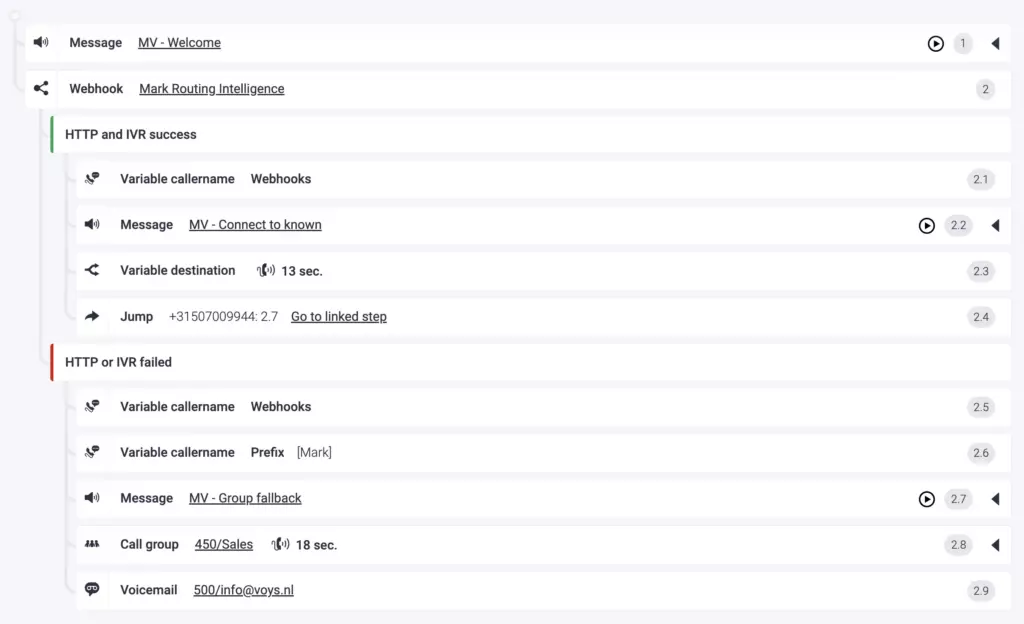
The calling plan with our Routing Intelligence system.
The takeaways: setting up smart call routing in your calling plan and CRM ownership
You don’t need to build anything to act on the findings of this study. Your Freedom calling plan already includes the “Smart order of ringing” method in the call group. When a customer calls back, Freedom reviews the calls from the past five days, both incoming and outgoing, and rings the phones of the colleagues who know this customer best first.
The rest of the team joins in a few seconds later, or immediately if the first group of colleagues isn’t available. It’s a smart system that ensures fast and accurate connections. That’s also why more than 30% of our customers already have this kind of smart calling plan set up in the system.
It takes just a few clicks, and even if you don’t do anything else with this entire blog series, just take a moment to see if you shouldn’t make this feature part of your call plan.
The other lesson: keep track of your CRM ownership. Not just because it looks neat, but because you’ll be able to use it later. This is becoming easier and easier with the AI tools of a good CRM and the integrations you can easily set up with your CRM at Voys via RedCactus.
One organisation, four companies: why team size determines your routing
It’s also important to note that this data comes from a single organisation; ours. We have a lot of callbacks and many ongoing cases. For an online store that handles one-time inquiries, that pattern is almost certainly different.
We do have the advantage of operating in multiple countries with different team sizes, so in effect, we’re four companies answering the same type of questions. The numbers reflect this: the same system achieves an 88.5% routing accuracy in Germany and a 62.9% accuracy in the Netherlands. Belgium falls in between at 74.2%.
That difference of over 25% is not a measurement error, nor is it due to the software. It is largely due to the number of people answering the phone at your organisation.
For the most part, that is, because the data from South Africa doesn’t fit that pattern. There, about fifteen people answer the phone, more than in Belgium and Germany, and yet the routing accuracy comes out at 47.6%: the lowest of the four. So team size doesn’t explain everything. Based on this measurement, we don’t know what the specific factors are in South Africa.